Decoding Your Son’s Meltdowns: Why Chaos Is Actually Communication
Why Your Child Has Emotional Meltdowns and What They Really Mean
Emotional meltdowns in children are not random, and they are not simply bad behavior. If you have ever wondered why your son seems to explode over small things or why calming down feels impossible for him in the moment, you are not alone. These reactions are often signs that your child’s emotional system has reached its limit, not that he is being defiant or difficult.
When we look at emotional meltdowns through a nervous system and relational lens, they begin to make much more sense. More importantly, we gain clearer and more effective ways to support our children.
Meltdowns Are Emotional Overflow, Not Manipulation
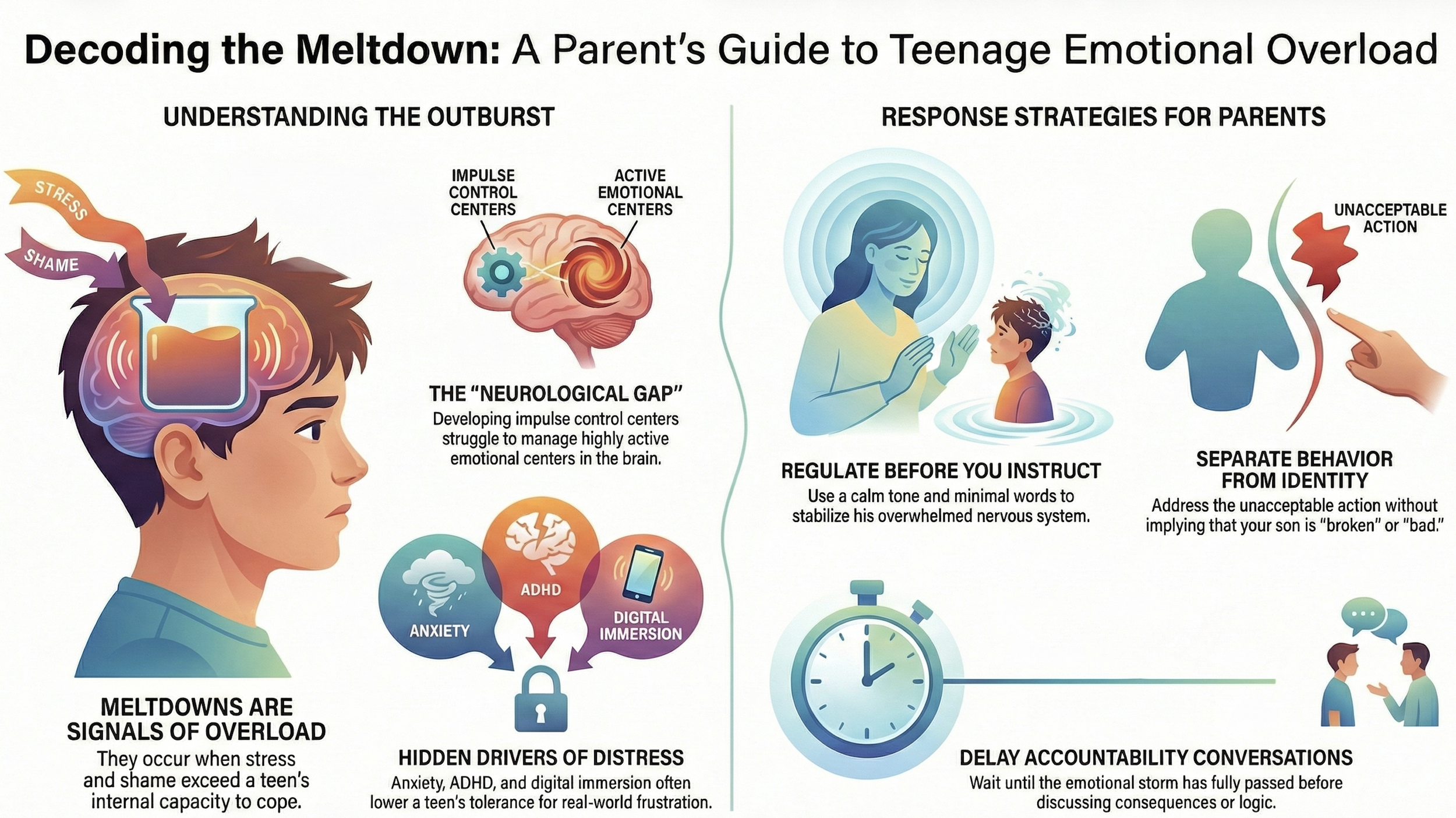
By the time a meltdown happens, your child is already overwhelmed. Stress has usually been building all day from school expectations, social pressure, sensory input, transitions, or simply the effort of trying to hold it together. The outburst you see is rarely about the immediate trigger. It is often the final drop in a bucket that is already full.
Children do not have emotional meltdowns because they want to lose control. They have meltdowns because, in that moment, their ability to regulate emotions has been exceeded. Their nervous system shifts into survival mode, where logic, reasoning, and self control are no longer easily available.
This is especially true for boys, who are often encouraged to push through discomfort, minimize feelings, or stay composed even when they are emotionally exhausted.
What Is Actually Happening Inside the Brain and Body
Throughout the day, children use an enormous amount of energy managing impulses, emotions, and expectations. For many kids, home is the first place they feel safe enough to let that effort fall apart. What looks like overreaction or regression is often a sign of trust. Their system finally feels allowed to release.
When a child is in this state:
Their brain is not in learning mode
Their body is signaling distress, not disobedience
Reasoning and consequences will not land until calm returns
Understanding this helps shift the question from “How do I stop this behavior?” to “What does my child need right now to feel regulated again?”
What Helps During an Emotional Meltdown
In the middle of a meltdown, the goal is not to teach a lesson or correct behavior right away. The priority is helping your child’s nervous system settle so regulation can return.
What tends to help most:
Your calm presence. Staying grounded yourself gives your child something steady to lean into.
Fewer words. Simple, reassuring language works better than explanations or lectures.
Connection before correction. Once calm returns, reflection and learning become possible.
Flexible closeness. Some children need physical closeness, while others need space. Both can support regulation.
Over time, responding this way teaches an essential lesson. Emotions are real and manageable, and behavior still has boundaries. When children experience both understanding and clear limits, they learn that feelings do not need to be feared, avoided, or acted out. They can be felt, managed, and expressed safely. This balance between empathy and accountability is what helps boys build emotional strength rather than emotional shutdown or shame.
Building Emotional Regulation Skills Over Time
The long term goal is not to eliminate emotional meltdowns completely. It is to increase your child’s capacity to handle stress, recover more quickly, and understand what is happening inside them.
This growth happens when:
Feelings are named and normalized
Emotional experiences are met with curiosity instead of punishment
Children learn regulation with a supportive adult before being expected to do it on their own
Teaching emotional language, validating feelings before problem solving, and modeling calm responses all help build a stronger internal sense of safety. Over time, your presence becomes something your child carries with them. It becomes a quiet reminder that big emotions do not mean danger or failure.
A Different Way to Understand Emotional Meltdowns
Rather than seeing emotional outbursts as defiance, it can be helpful to see them as communication. A meltdown is often your child saying:
“I am overwhelmed”
“I do not have the words for this yet”
“I need support before I can regain control”
When adults respond with steadiness, clarity, and care, children learn that emotions are manageable and that they do not have to face them alone. That foundation supports resilience, emotional confidence, and healthy independence, not just now, but into adolescence and adulthood.